What AI Readiness means, and what it unlocks.
AI now decides how your clients are found, read, and recommended. The Agency Revenue Radar assesses that picture automatically, across whole client estates, and hands you board-ready evidence. The work that opens revenue arrives ready to go, without drawing on your own team.
Reframed for agencies, from the AAAnow board briefing and research paper.
The conversation you own
Most AI conversations are inside-out: how an organization will use AI inside its own walls. This page is about the other direction. The outside-in view is the picture AI builds of an organization from what it can find online, and it is forming whether anyone is managing it or not.
That makes it an agency conversation, not a client IT project. It is about how a client is found, understood, trusted, and recommended in the places buyers now look. You can be the partner who brings that picture to the table, with evidence, rather than the one having the same general AI conversation as everyone else.

What AI sees, not what they say
AI reads the full footprint a client has ever made available, not only the content they consider current. Years of published material, third-party references, archived assets, and legacy domains all feed the picture the market then acts on.



So the picture is assembled largely from material the client does not own and does not always remember is still online. And the audience is moving there fast.
Harvard Business Review reports 58% of consumers turned to generative AI for product or service recommendations in 2025, against 25% in 2023. Deloitte reports more than nine in ten retail leaders expect AI to be used more than traditional search by 2026.
Similarweb reports zero-click search on Google grew from 56% to 69% in the year after AI Overviews launched, with the audience intercepted before it reaches the source.
What it exposes for your clients
The exposures share one root cause: AI is reading material the client does not own, does not manage, and often does not know is still visible. Three consequences follow, and each is a board-level concern.
Misrepresentation.
Superseded guidance, withdrawn products, or out-of-date terms can be returned as current. In the paper, a national regulator’s documents carried broken links and duplicate titles, and 84% of AI-generated summaries from them contained inaccuracies, with correction estimated at 650 hours of work.
Missed visibility.
When the foundations are weak, a client is omitted from the answers, comparisons, and recommendations AI now assembles, while competitors who are read accurately set the comparison the market uses.
Lost trust.
A financial promotion left on a partner site returned cover levels that conflicted with the policy, at the point of a customer decision. Accuracy at the source decides what AI tells the client’s customers.
Use cases
Across sectors the same root cause surfaces in the same way: AI reading material a client no longer recognizes as its own, and acting on it in front of customers, citizens, and regulators. These are extracts, summaries from information available online, and examples of specific failures. The names of organizations have been removed.
Pharmaceutical
Prescribing information, administration guidance, and patient material sit across a client’s own sites, partner sites, and historic documents. Older versions stay online beside current ones, and AI now reads all of it to answer clinical and patient questions on the client’s behalf. Accuracy at the source decides what AI tells them.
During the pandemic a company stood up a site to gather documentation in one place, built at speed for clinicians, administrators, and the public. The usual compliance oversight was not applied, a reasonable trade-off at the time. The site stayed online afterwards. Superseded documents still sit beside current ones, and products no longer offered are still presented as available. One withdrawn product still carries full guidance on how it should be administered, and AI reads the site and returns that as current clinical instruction.
Local and municipal government
Councils publish policy pages, archived service procedures, older departmental sites, and PDFs. As AI agents act on behalf of citizens, that published estate becomes the operating manual, and inaccurate or outdated content surfaces in chatbot answers and voice services.
An authority launched a chatbot for citizen inquiries. AI read the published estate, including a two-year-old planning microsite the digital team had no record of, and treated its structured PDFs as authoritative, returning them as current planning guidance. Planning applications failed on the back of wrong information. The chatbot was withdrawn after a legal challenge and reputational damage. The digital team had warned of the sprawl for years, and the first step in correcting AI was understanding the actual footprint.
Government regulator
Regulators publish legislation, guidance, handbooks, and PDFs that AI now reads on behalf of the organizations they oversee. When versions conflict, procedures no longer apply, or links point to material that has moved, AI returns answers that carry those conflicts forward.
A national financial regulator publishes key legal documents as PDFs that link out to other content. One in five of those links is broken, including the core legal basis for some documents. The files are poorly named, and pages within each PDF share the same title, leaving them effectively unreadable to AI tools. 84% of AI-generated summaries from these documents contained inaccuracies, with the potential to give wrong positions on legal and regulatory matters. Correcting AI’s understanding was estimated at 650 hours of work.
Financial services
Financial firms run data-heavy sites, forms, product disclosures, and regulatory communications that customers and AI agents now interrogate to act. AI reads what is published, so outdated content produces wrong answers at the point of a financial decision, hitting customers directly.
A financial institution ran a joint promotion on a partner site two years earlier. The products covered no longer applied to that market, and no central record of the shared positioning existed. AI surfaced the partner page as current product information, and a regulatory inspection followed, citing misrepresentation of products to a market the firm could no longer serve.
A holiday insurance promotion was published online, but the page differed from the underlying policy. Cover levels on the page conflicted with the contract, and the emergency contact had changed to a global 0800 number not shown on the page. AI returned the outdated page to customers, producing wrong cover information at the point of need.
Electrical product manufacturer
Manufacturers sell into many countries, each with its own safety standards and approved usage. Manuals, datasheets, and safety notices have to match the market where a product is used, and AI now reads them to answer how a product is installed, configured, and operated safely.
A manufacturer has out-of-date safety information spread across its published material. Multiple manuals and versions of the same product data sit across the estate, and the links inside each point to material that has moved or been superseded. AI cannot resolve which version is current, so it returns setup and safety guidance that no longer applies. The consequences show up in support: customers cannot set up their devices from the information they are given, support contact rises, and product returns are materially higher. Brand quality is judged on a setup experience the manufacturer no longer controls.
What it unlocks for the agency
This is where the outside-in view becomes commercial.
AI readiness gives you a reason to talk to each client about being found, being heard, and being recommended, backed by independent evidence rather than opinion. It is a way to show the agency is moving forward with AI, putting it to good use, instead of repeating the same conversation or pushing back against the technology.
Because the assessment is automated and runs at scale, the evidence is ready to go without tying up your team, so you can open these conversations across the book of business at once rather than one slow audit at a time.
The framework
The framework is independent of any single vendor and runs in three layers, in one order. Fundamentals carry the structure of what AI can read. Governance keeps it correct over time. Visibility surfaces the result.
What AI can find, read, interpret, and act on across the estate. Page and document structure, findability, authority and provenance, accessibility, consistency, and the technical health that holds it together. The other layers are built on this one.
What keeps the information correct, current, and accountable over time. Named ownership, a review rhythm, authority for change, evidence of decisions taken, privacy and trust controls, and digital efficiency.
What surfaces the result. The discipline the market now calls Generative or Answer Engine Optimization. On sound foundations it surfaces material AI can read and the client can stand behind. Without them it amplifies whatever is already in circulation.
The order is load-bearing. Reverse it, and you promote what has not been verified.
The maturity scale
The maturity scale measures the fundamentals layer on a 0 to 100% range, in six bands. It is a maturity model, not a vanity score: a position a board and senior leaders can read, understand the exposure behind, and act on. It moves as the estate moves, so it stays an honest reading rather than a one-off snapshot.
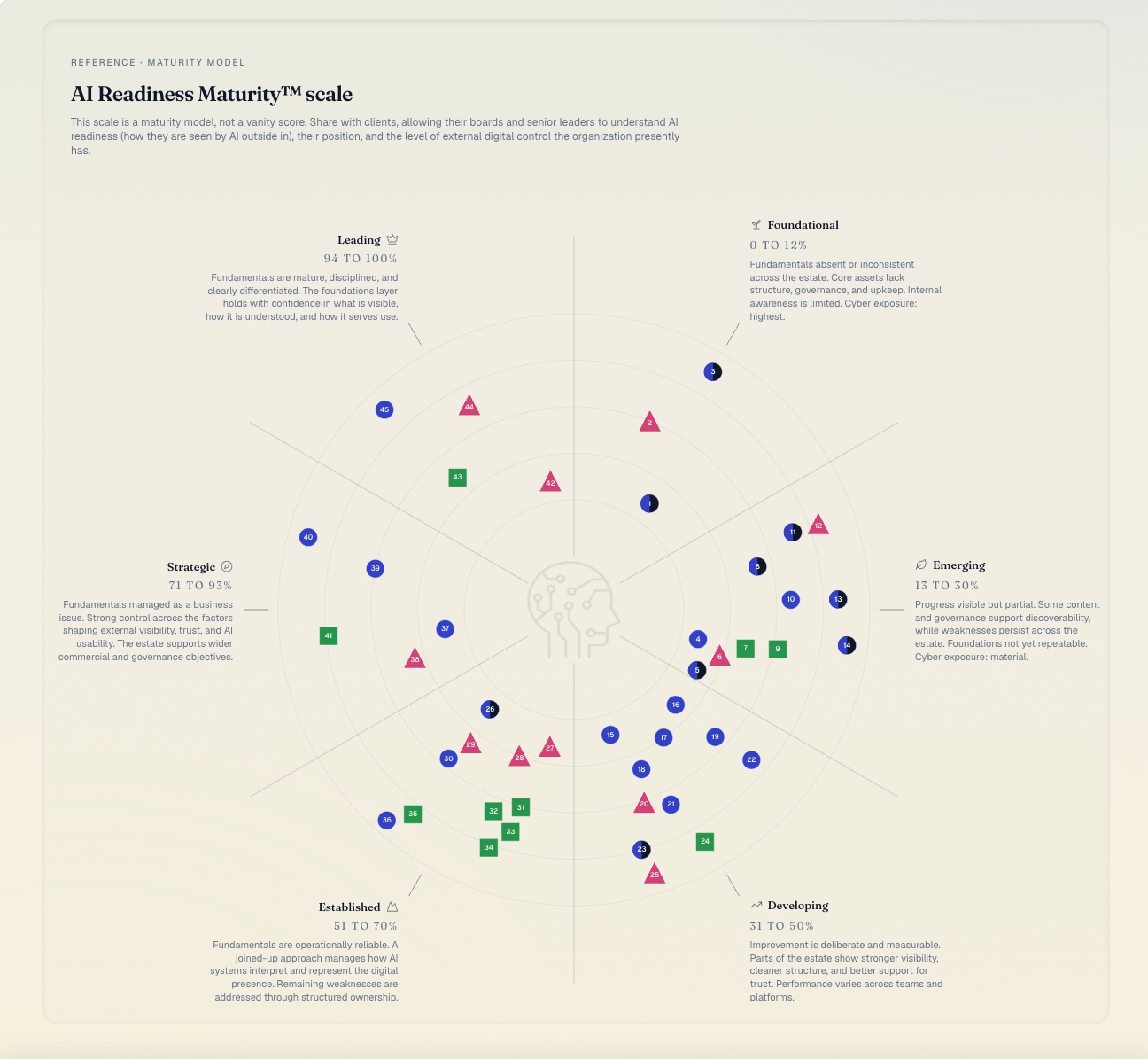
Agencies use the scale to map a client’s whole digital landscape, or a single site, against a recognized position their board can read and act on.
The ten principles
Each digital property is assessed against ten principles, scored separately for web pages and PDF pages. They set out what AI sees when it reads the property, and whether that reading produces an accurate picture. A site can score well on one and still fail the picture AI assembles, because AI reads across all ten.
The first forty-five days
The first move is a baseline that shows what AI can currently find, interpret, trust, and reuse across a client’s external estate. It is produced quickly enough to inform ownership and priorities, not to resolve all weaknesses at once.
It gives the board a factual position to hold, a named owner who can be accountable, and a first plan for reducing exposure. From there, AI readiness moves from a one-time concern to a managed discipline: reviewed, evidenced, and improved over time. Discovery keeps running underneath it, bringing forgotten and third-party material into view, because the footprint is never static.
For the agency, that is a clean sequence to sell and to run. The assessment and discovery are automated and repeatable, so what you bring to each client is current, scored, and ready to act on, with the heavy lifting carried by the instrument rather than your people.
Closing position
What AI sees and what a client says are now two different things. The first is read by the market, the second sits inside the business. The work of AI readiness is to make those the same picture, and to keep them the same as the outside world keeps moving. The fastest way to see it is to put one real client site through a scan and bring the findings to your next conversation.