From first contact
to advocate.
Each service inside The Agency Revenue Radar does one defined job at a single stage of the client relationship, turning an outside-in read of how AI sees a client into a reason to make contact.
Follow the thread and the same reading carries an account from a cold prospect to a named advocate, inside the conversations account teams already hold, with nothing new to run.
Below, the services traced to the stages they carry.
Introduction
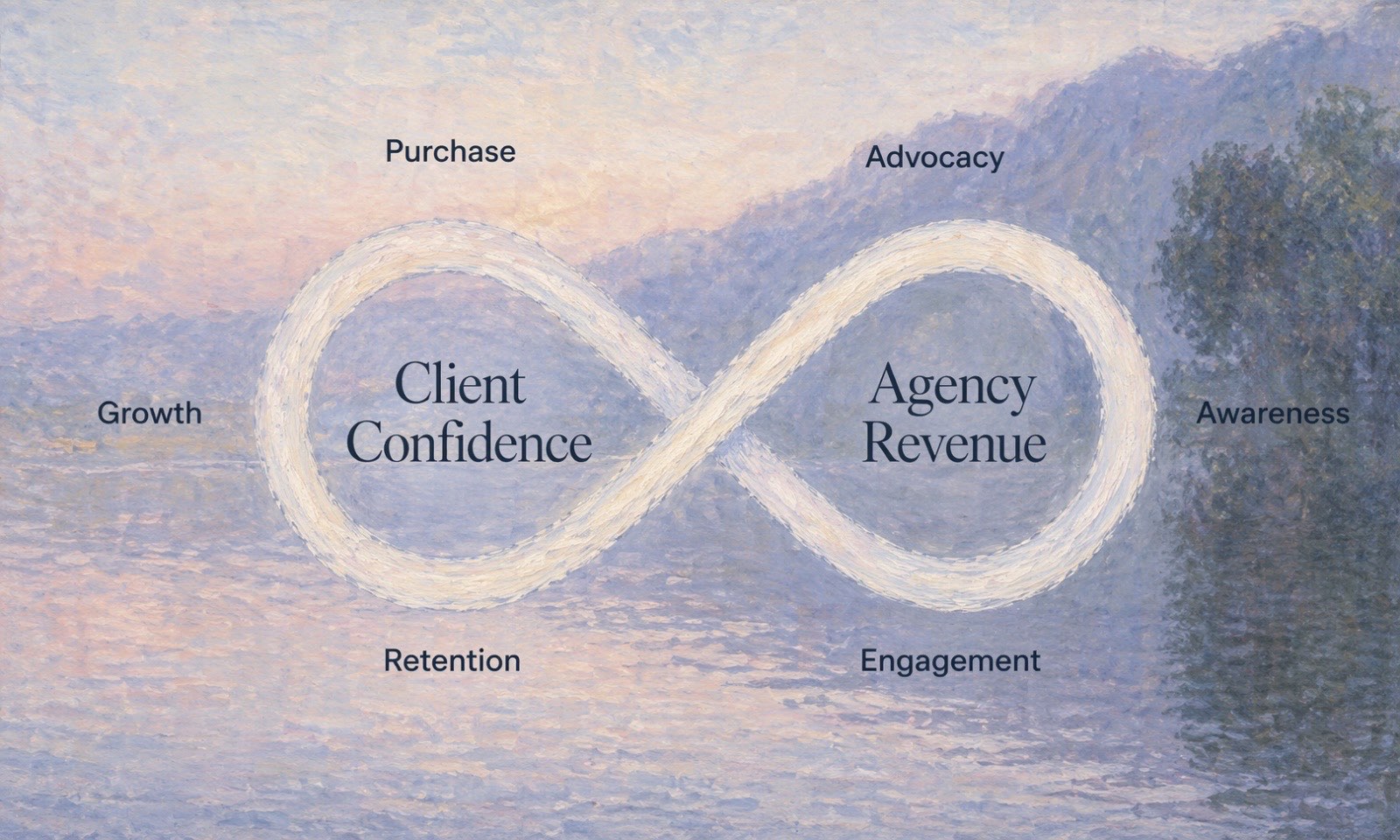
This page introduces the client lifecycle as a single commercial engine, built on Ai supported reporting across six stages. Awareness, Engagement, Purchase, Retention, Growth and Advocacy.
It is written for agency leaders looking at where revenue is leaking across the account base and for the people inside the agency who own each stage in practice. The sections that follow walk through the stages one at a time, then read them together as one engine.
The image below is the one-picture version of the argument. Each section after it is a working placeholder to be replaced with the final stage copy.
Awareness
Evidence helps agencies start conversations with substance and stand out from generic competitors.
Awareness is when a prospect first notices the agency. Instead of relying on broad claims or creative showcases, the agency introduces evidence drawn from measured fundamentals. Using high level results created through the platform, agencies highlight where sectors or specific organizations may be underperforming. This changes the starting point. Prospects see something concrete, not a general opinion about digital practice.
Agencies can use individual site summaries for direct outreach, or aggregate sector results for broader campaigns and PR. These outputs highlight where value is slipping or where unnecessary risk is increasing. Because the information is structured and repeatable, it supports email contact, webinars, content marketing, and targeted approaches without adding complexity.
Awareness becomes stronger because the first interaction carries relevance. A prospect can see that the agency understands the landscape and can speak about fundamentals using measured results. That creates a natural reason for a conversation. The agency is positioned as practical, informed, and focused on improving the prospect's situation rather than making generic introductory claims.
“Evidence creates interest and helps agencies cut through noise.”
Engagement
Clear results give agencies a shared reference point to discuss a prospect's current situation.
Engagement is when interest becomes a detailed conversation. The agency presents a factual view of where the prospect stands today, based on summaries of Value and Risk across the fundamentals. This creates a shared foundation for discussion. The agency is not relying on assumptions. It is showing the prospect a structured way to understand their current position.
Depending on the opportunity, this may involve a single site or a small group of sites. For larger proposals, the agency can explain how this view will continue each month once work begins. The prospect sees both the starting point and the practical method the agency uses to maintain visibility over time.
This approach reduces uncertainty. Senior stakeholders do not have to interpret technical reports. They see a consistent framework that highlights areas performing well and areas that need attention. Engagement becomes focused and grounded in evidence rather than subjective assessments. The agency demonstrates how it will create clarity from day one and maintain that clarity across the relationship.
“Clear results give both sides a shared starting point for discussion.”
Purchase
Structured oversight removes client distraction and brings order and clarity to ongoing support work.
Purchase is the point where the working model is agreed. The agency positions structured oversight as part of its support approach, helping the client reduce the effort and distraction associated with monitoring content and fundamentals. Monthly summaries highlight where Value is improving, where Risk is rising, and where action is needed. These summaries are predictable, consistent, and easy to interpret.
Where deeper content work is required, the agency can provide a structured view of the actions involved. The client chooses whether to allocate this work internally or include it within the agency's support package. Either way, the agency provides a clear and repeatable mechanism for understanding priorities.
This reduces the client's manual checking and removes the uncertainty of ad hoc findings. The agency avoids leaving money on the table by incorporating oversight and action into the contract rather than allowing this work to drift elsewhere.
The relationship starts with clarity and sets expectations around how issues will be seen, communicated, and addressed. The client no longer carries the burden of chasing detail, and the agency maintains a more organized and predictable workflow.
“Structured oversight removes distraction and brings order to support work.”
Retention
Regular reporting keeps progress visible, reduces surprises, and stabilises long term client relationships.
Retention is driven by consistent, factual reporting that shows how fundamentals are being maintained. Each monthly summary presents a clear picture of the current position, highlighting improvements made and new issues emerging. This removes the uncertainty that often causes dissatisfaction, where clients only discover problems once they become visible or disruptive.
For agencies, these summaries create a stable rhythm for communication. Instead of waiting for issues to be raised, they contact clients with an update based on measured findings. Discussions become orderly and predictable. Priorities can be agreed quickly because both sides are working from the same reference point.
Retention also benefits internal efficiency. Automated oversight reduces manual work and frees team time for planning, explanation, and higher value support. The agency becomes easier to work with because surprises reduce and communication feels regular and reliable.
Clients remain confident because they see ongoing attention to fundamentals rather than reactive fire fighting. This stability avoids unnecessary churn and ensures that value stays within the relationship instead of leaking to external tools or unmanaged internal processes.
“Regular reporting keeps progress visible and reduces surprises.”
Growth
Visible patterns highlight practical opportunities to expand work and deepen existing account value.
Growth emerges when patterns in the summaries reveal areas where focused work will make a measurable difference. Repeated issues, stalled improvements, or gaps between sites provide a clear basis for new proposals. The agency is not making speculative suggestions. It is referring to information the client already sees each month.
This reduces the effort required to justify new work. Clients understand the relevance because they have already discussed the underlying issues. The conversation becomes about scope, sequencing, and priorities, not about convincing the client that a problem exists.
Growth also includes revenue that now remains inside the agency. Oversight and related content work are less likely to drift to external suppliers or unmanaged internal effort. As more sites or teams adopt the model, the structure scales without significant additional burden.
The result is a broader, more stable relationship. The agency gains deeper involvement across the digital estate and provides support that aligns directly with measured needs. Growth becomes a natural extension of the consistency already in place, not a separate sales activity.
“Patterns highlight practical opportunities to expand work already underway.”
Advocacy
Consistent results make it easy for clients to explain the relationship and recommend the agency.
Advocacy develops when clients can describe the relationship using clear, repeatable evidence. Over time, the summaries build a record that shows how issues have been surfaced, prioritized, and addressed. This record is easy to share with colleagues and leadership. It provides a straightforward explanation of the value the agency delivers.
Because the information is direct to interpret, clients do not need to rely on subjective statements. They can point to specific reports that illustrate progress and stability. This makes it easier to justify ongoing spend and to introduce the agency to other teams or departments.
Advocacy also appears in how often the agency is invited into new discussions. When fundamentals are clearly monitored and understood, the agency becomes a natural partner for future plans. Their reputation is based on consistent control and steady progress, not occasional success or unpredictable cycles of issue resolution.
Clients who feel informed and supported become natural promoters of the relationship, helping the agency gain visibility inside and outside the organization.
“Consistent results make the agency easy to explain and recommend.”
The lifecycle, read end to end
Placeholder copy. A short narrative that reads the six stages as one continuous commercial instrument rather than six separate boxes.
Second placeholder paragraph. What the agency sees on a dashboard, what the client sees in a meeting, and where the two meet.
How it slots into current workflows
Placeholder copy. The specific rituals, documents and meetings Radar plugs into without requiring a new process.
Second placeholder paragraph. What the account team has to change on day one, which is almost nothing.
Where the commercial value lives
Placeholder copy. A plain statement of where the uplift shows up: new business, retention, expansion.
Second placeholder paragraph. Indicative numbers, to be replaced with the agency's own figures once the first cycle is complete.
Closing position
Placeholder closing paragraph. A short, subtle note inviting the reader to see the engine in action on one of their own accounts.