A loss that kept paying attention.
Losing a client rarely ends the story. When a long-term account moved its website to another agency, performance collapsed: load times stretched to nine seconds, bounce rates climbed, and sales suffered.
Because the client remained on the Scorecard, the original agency spotted the decline, stepped in with evidence, and rebuilt the relationship with a $40,000 engagement. This is how a lost pitch became revenue, step by step.
01What we wanted to solve
Pitching for new work is high-cost and high-risk. Agencies often lose out even when they hold a trusted client relationship. The challenge was to show how a lost pitch can still generate revenue and strengthen a long-term client relationship.
02What we used
The agency had supported a major high street name for three years. When the client went to market for a new website, they selected another agency, who were contracted to upgrade Sitecore. Even though the account was lost, the original agency kept the client visible on the Scorecard.
The Scorecard alerts with a single grade per category. The lost client stayed on the dashboard, and Experience fell for two consecutive months, dropping to an E. That triggered review, investigation, and outreach.
Scorecard puts powerful insight in the hands of the commercial team. A red light on the dashboard is all it takes to turn a conversation into revenue.
03What we found
Measured results from site analytics and the page waterfall confirmed a severe performance problem on the main landing journey.
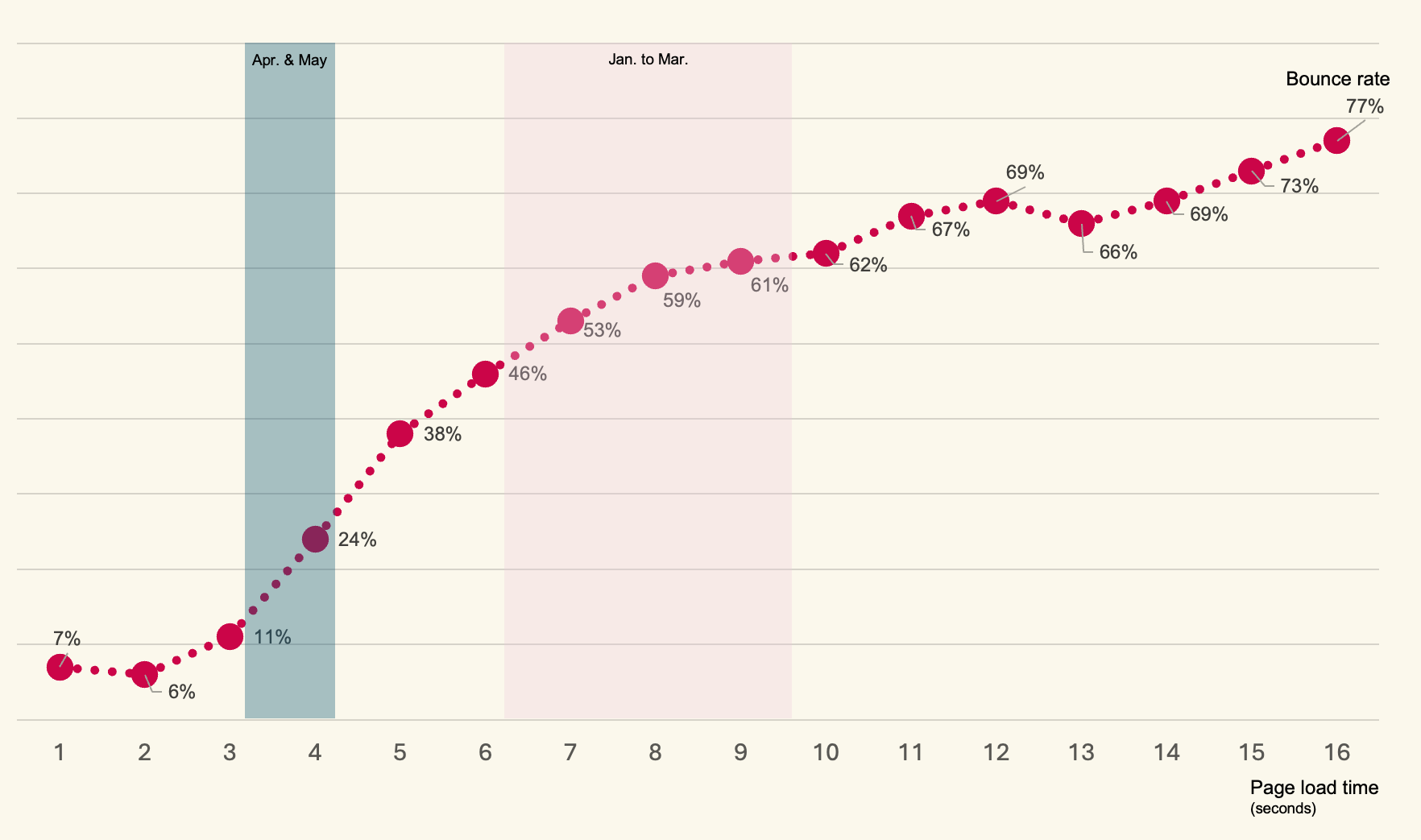
- January to March: maximum page load time rose from 6.22 to 9.43 seconds.
- Over the same period, bounce rate climbed from 48% to 61%.
Contributing factors included code and third-party conflicts, among them issues with a cookie self-generation and management tool. The new agency proposed a re-platform, quoted at $120,000 to $127,000. By then, the relationship had broken down.
04What we did next
Using the Scorecard alert as the prompt and the measured results as evidence, the original agency set out a fix plan. They had already invested six days diagnosing the issue. They scheduled 13 days of actual work, elapsed over a month.
They reviewed the page waterfall ahead of their performance pitch and offered a clear guarantee: a 50% service performance improvement within 90 days. The engagement was priced at a fixed $40,000.
05The outcome
The problem was resolved within the month. Load times were reduced, and bounce rates fell to 24% in April and then 11% in May. That is still too high, and further optimization is underway with a goal of 5%.
The agency delivered a $40,000 project that rebuilt trust and reopened the relationship. Overall, the estimated lifetime value is $765,000.
06The lesson
Keeping a lost client on the Scorecard provided independent alerting on fundamentals. When Experience turned red, the agency used measured results to quantify impact, propose a fixed remedy, and win the client back.
What looked like a loss became a route to revenue and a stronger long-term contract.
A note on the Scorecard
This article is based on the forerunner to The Agency Revenue Radar: the AiSC Scorecard, still available today, focused on human experience against Value and Risk.